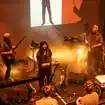
That philosophy extends beyond music. Globo make their own live visuals or commission artists to create them. For their Norwich album launch they constructed exhibition boxes themselves, cutting, gluing, filling, sanding and painting the wood. Thompson and Appleton went further, altering old Top Trumps cards depicting tanks, fighter planes and heavy artillery with paint and ink before giving them away at the show. “We’re very engaged in those kinds of processes now,” says Wernham. “It’s rewarding and expands the meaning of being a band. It’s messy though. Lots of hoovering and wiping required.”
That sense of physical process provides a curious counterpoint to the way Globo originally worked. Music moved between Norwich and London on floppy disks. Akai samplers, digital synths and drum machines were assembled before the band mixed directly to DAT, with limitations becoming part of the creative process. “We had to mix them in heat of the moment,” Wernham remembers. “It made the mixing process part of the writing process. It involved us all leaning over mixing desk and shifting faders.”
He compares nostalgia for that technology to the romance surrounding analogue photography. Having learned photography with an SLR, developing his own negatives and prints, he once decided to revisit the process. “I immediately realised that it was massive pain in the arse!”
Technology has, however, proved invaluable in reconstructing the music for live performance. Many keyboard parts had originally been recorded directly without retaining MIDI information. Stem-splitting software allowed Globo to separate elements and analyse what their younger selves had played. “A lot of the prettiest piano parts on the album were improvised there and then and forgotten,” Wernham explains, “so I had to learn them in a way more disciplined manner so I can play them live.” Doing so with Globo's densely layered music wasn't necessarily straightforward. “Stem splitting dense collages of samples and electronic sound and textures is not as easy as doing with a four-piece rock and roll band.”
One significant difference between the two versions of Pro War is the inclusion of Globo's early singles. In the '90s, the group deliberately regarded singles as standalone releases rather than simply extracting tracks from forthcoming albums. Onward, originally the B-side to Beautiful Feeling, subsequently developed an identity of its own after being used on Stewart Lee and Richard Herring's BBC series Fist Of Fun.
There was another influence hiding inside it. “One thing about Onward that I’m not sure anyone has commented on before, is that it’s referencing Get It On by T-Rex,” Wernham reveals. “I suppose people weren’t expecting a T-Rex reference on a mid-90s electronic music 12-inch.”
Bringing Onward, Beautiful Feeling and Autosleeper into Pro War (Redux) has subtly altered the album. “Putting Onward, Beautiful Feeling and Autosleeper on the album has probably made it feel a bit more focused perhaps,” he says, before adding with characteristic uncertainty: “I’m not sure.” That refusal to impose too rigid an interpretation feels entirely appropriate for a group that never comfortably belonged to a scene in the first place.
Wernham remembers signing to Hydrogen Dukebox and heading out to celebrate at a Megadog event in north London, where Loop Guru were playing. “We were friendly with them, but we weren’t never part of that scene either,” he recalls. “People at that event looked at us like we were the drug squad or something because we had short hair and were wearing suits. We didn’t stay long.”
Today, the mechanisms through which leftfield music finds its audience have changed beyond recognition, although Wernham argues that curation remains essential. Where once there was the weekly music press, John Peel and television programmes such as Snub and Anglia TV's Transmission, discovery is now dispersed across countless digital channels.
Yet live music offers something else. Globo are due to appear at Shadowlands Festival alongside artists including Foetus, Test Dept, The Wolfgang Press, Negativland, Immersion and Hula, a bill Wernham compares to the post-punk Futurama festivals of the late '70s. “Very encouraging that there’s a place for Globo in that.”